
Guides · Compliance
What are the new recycling rules for businesses?
Simpler Recycling requires every workplace in England to separate dry recyclables, food waste and general waste on site before collection. Businesses with 10 or more full-time equivalent staff have had to comply since 31 March 2025. Those with fewer than 10 have until 31 March 2027.
Talk to us about separating your streamsWho does Simpler Recycling apply to?
Simpler Recycling applies to every workplace in England, including businesses, charities, schools, offices, shops and cafés. It is not a London rule and it is not a large-company rule. Only the deadline differs.
- 10 or more full-time equivalent staffThe rules already apply and have done since 31 March 2025.
- Fewer than 10 full-time equivalent staffThe deadline is 31 March 2027.
Full-time equivalent is where people miscount. Two staff on half hours count as one, and volunteers and contractors do not count at all. A shop with eight full-timers and four part-timers on twenty hours a week sits at ten, so the rules apply now rather than in 2027.
What waste do businesses have to separate?
Three streams have to be kept apart: dry recyclables, food waste, and everything else. Dry recyclables means plastic, metal, glass, paper and card.
There is a wrinkle inside the dry recycling that catches collectors out as often as customers. Paper and card must be collected separately from plastic, metal and glass, unless the collector has completed a written co-collection assessment showing that separating them is not technically or economically practicable, or would deliver no real environmental benefit. Plenty of collectors complete that assessment and then collect dry recyclables together, which is legitimate. Ask yours to show you theirs.
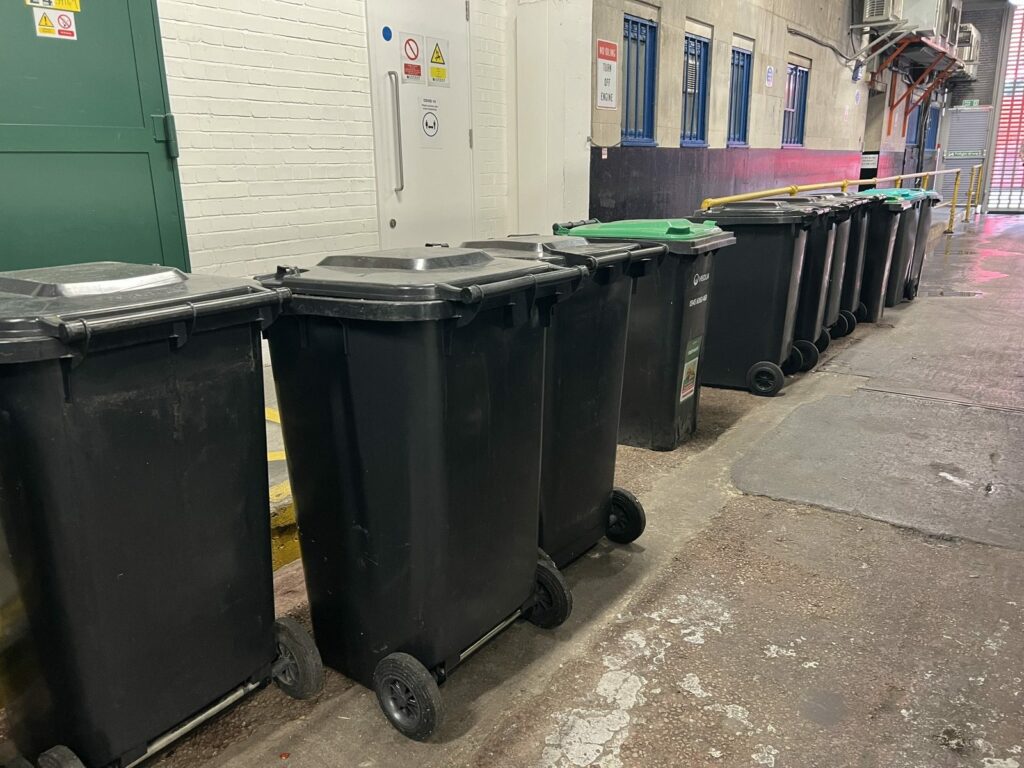
Wood is its own stream and does not belong in dry mixed recycling. If yours is mostly pallets, see who collects used pallets in London.
Does Capital Recycle collect glass, food and cardboard?
Yes. Capital Recycle collects general waste, dry mixed recycling, glass, food waste and cardboard for London businesses, so the separation Simpler Recycling requires can be handled on one account.
Glass needs a dedicated container rather than going into dry mixed recycling, because drinking glasses, window glass, light bulbs and crockery are not container glass and contaminate the load. Food waste is collected as a sealed stream. Cardboard travels inside dry mixed recycling until the volume justifies its own collection. Pricing on glass, food and cardboard is quoted per site rather than published.
Do offices need a food waste bin?
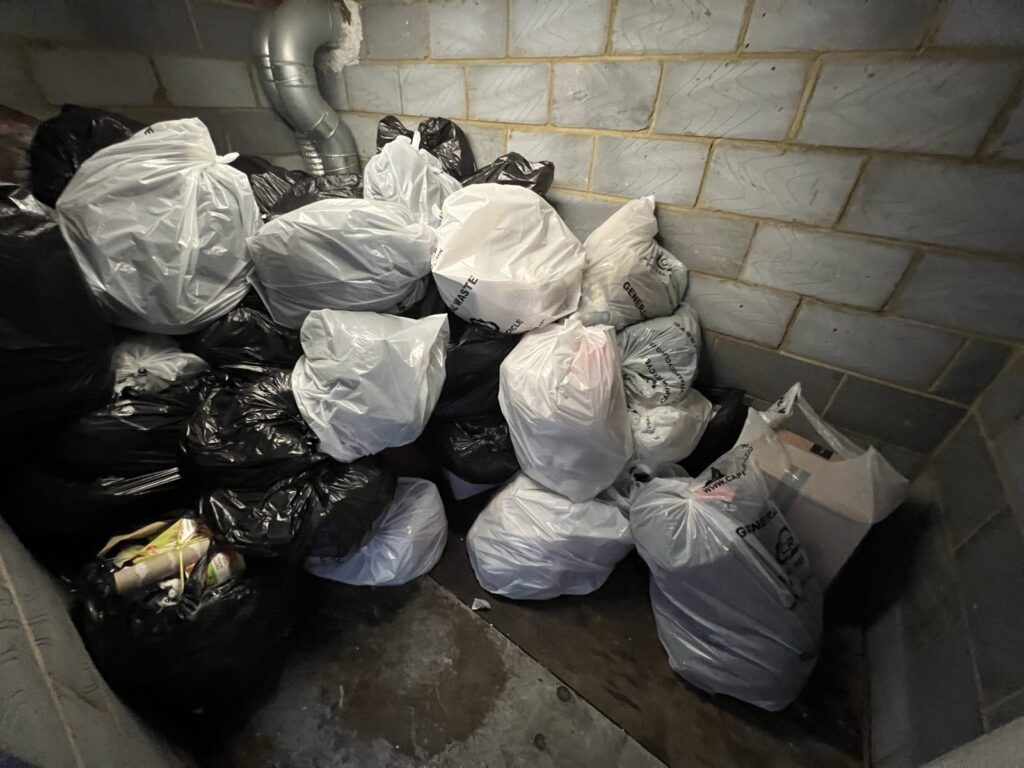
Yes. Food waste has to be collected separately whether or not the premises serves food, and regardless of how little there is. If staff eat lunch at their desks, the workplace generates food waste.
Can a waste company make my business compliant?
No waste company can sell compliance outright, because it depends on what happens inside your building before anything reaches the collection. What a collector can do is take each separated stream and document it.
Capital Recycle handles the collection side of the separation across London and issues a Waste Transfer Note for every collection. What is left is the part inside your premises: the bins, the labelling and the habit.
Compliance is a paperwork question as much as a bin question. Full detail: do I legally need a commercial waste contract?
Separate streams usually mean separate containers. See commercial bin collection for how the bins are set up.
Who enforces Simpler Recycling?
The Environment Agency enforces Simpler Recycling in England, and non-compliance is an offence that can attract a compliance notice and enforcement action from there.
In practice the regulator is rarely what bites first. For most small businesses it is a client audit, a landlord, or a tender asking for proof of how waste is separated and where it ends up.
What should a business do first?
Start by checking whether your recycling and general waste are genuinely separate all the way out of the building, or whether both bags end up in the same bin at the back. If it is the second, that is the fix, and it is not a complicated one.
Whoever collects your waste has to give you the paperwork for it. Full detail: what is a waste transfer note and do I need one?
Need the streams sorted?
Tell us the premises, the postcode and which streams you generate. Call 0207 101 4003 or use the contact form.
Contact us